
NOTE: This tool will be updated with a link to the hosted tool and/or source code as soon as it is available. Thank you for your patience during our transition.
Reconstructing past changes to the shape and volume of the Antarctic ice sheet relies on the combination of physically based numerical ice sheet models matched with geologic records of ice sheet mass loss. Cosmogenic nuclide measurements record the progressive exposure of mountain peaks, thus providing key geologic information to constrain the history of ice sheet deglaciation. These exposure-age datasets are spatially limited, but we can use ‘best-fit’ model simulations to extrapolate these mountain-side records to reconstruct regional deglacial behavior. Selecting a ‘best-fit’ model simulation, however, necessitates a robust model-data scoring methodology.
This tool extracts modeled ice thinning histories at any given site around Antarctica, spanning the last deglaciation (20 ka to present). If the specified site contains cosmogenic nuclide exposure-age measurements of ice surface deflation, the tool plots and calculates a model-data misfit score for each selected model.
A detailed account of the model-data scoring methodology can be found in [ref: Halberstadt et al, submitted], where we describe the development and use of a model-data evaluation framework using terrestrial exposure age data. In that paper, we compute site-by-site model-data misfit scores (as plotted here) and then we combine site scores across the continent to assess and interpret Antarctic-wide model scores. We also describe the implementation of a nested model framework in which high-resolution domains (2 km resolution) are downscaled from a continent-wide ice sheet model.
This tool provides hands-on, interactive access for evaluating model performance at specific sites around Antarctica, especially where exposure-age data have been collected.
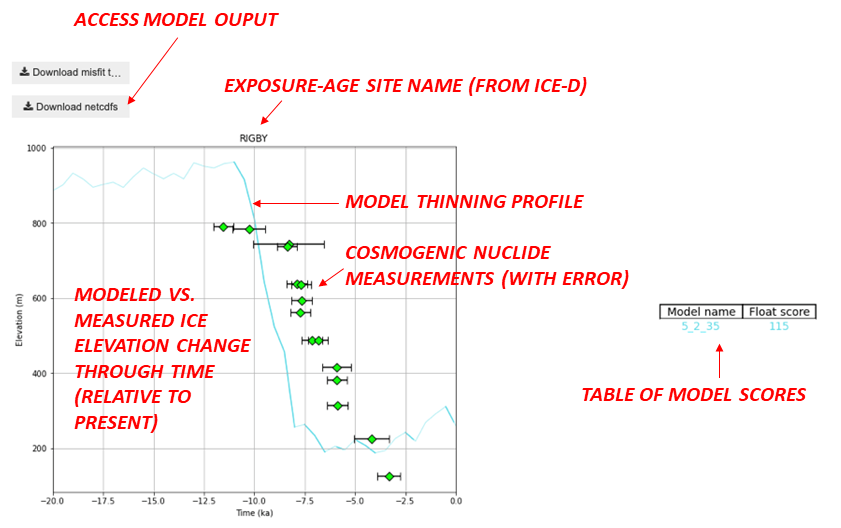
Below shows an example of using this tool to investigate which model simulation best matches a site of interest (say, RIGBY). Model thickness profiles, extracted at the specified site location, are plotted for all selected model simulations (colors randomly assigned). For each model, model-data misfits are summed across each sample at the site, and the total model score is tabulated.
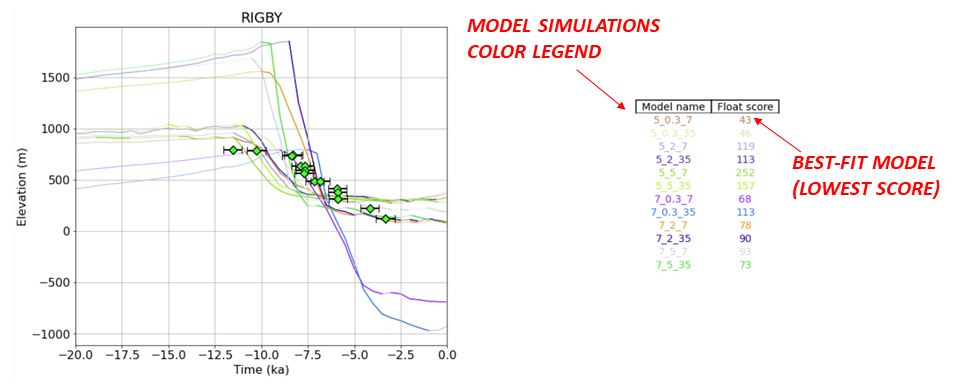
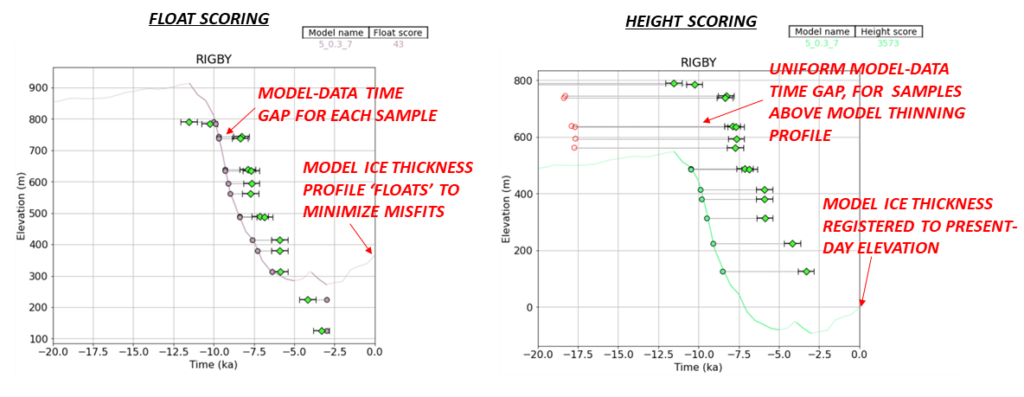
Model simulations can be scored with the ‘float scoring metric’, where the model ice thickness curve is vertically offset (floats) to minimize model-data misfit. This approach is motivated by issues with aligning model thickness change to a modern baseline, due to model resolution issues (see accompanying manuscript for more details). A more traditionally used ‘height scoring metric’ (where model ice thickness changes are registered to the modern model ice surface) can be selected in the dropdown menu under ‘Misfit calculations’.
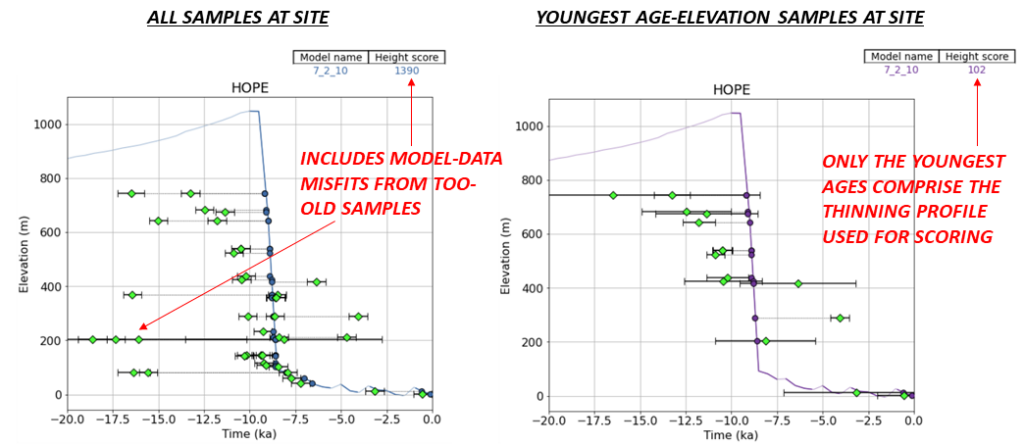
Note that when an ICE-D site is selected, all samples are queried from the database. However, cosmogenic nuclide datasets are often plagued by an old bias. Models should be scored using only the youngest age-elevation samples, which theoretically reflect the progressive exposure of the site as the ice sheet deglaciated. Selecting the option ‘Calculate and use only the youngest age-elevation-bounding samples’ will apply an automated script to identify these youngest samples (though this process can take up to about 15 min to compute).
When citing the tool, please use the citation listed below that includes the Zenodo-generated DOI.
Credits
Funded by NSF OPP PRF 2138556